HALLELUJAH! GOD IS A WOMAN VOL.2
ETHEL COPPIETERS, SAMIRA HODAEI, NATACHA MANKOWSKI, DONGLAI MENG, SALI MULLER, SAAR SCHEERLINGS
16 JULY - 12 SEPTEMBER 2026


The exhibition Hallelujah! God is a Woman, Vol. 2 is the second edition of a group show celebrating the work of six female artists, following the first edition held in 2021. Featuring both long-time collaborators and newly represented talents, the exhibition reflects the gallery’s commitment to supporting women in contemporary art. Through a variety of media and techniques, the show highlights the diversity of artistic practices and perspectives, creating a dialogue between different generations, styles, and forms of expression.
Ethel Coppieters (*1996, BE) and Donglai Meng (*1994, CN) work through figuration to give shape to personal and collective narratives, from monumental portraits rooted in sisterhood to dreamlike scenes drawn from urban legend. Natacha Mankowski (*1986, FR) and Saar Scheerlings (*1990, NL) explore the expressive potential of matter itself: Mankowski through sculptural layers of impasto, Scheerlings through antique linens salvaged and rewoven into talisman-like forms. Samira Hodaei (*1981, IR) and Sali Muller (*1981, LU) turn instead to perception: dotted landscapes and reflective works that shift with light, space, and the viewer's own presence.
ETHEL COPPIETERS
Born 1996 in Brussels, Belgium.
Lives and works in Brussels, Belgium.
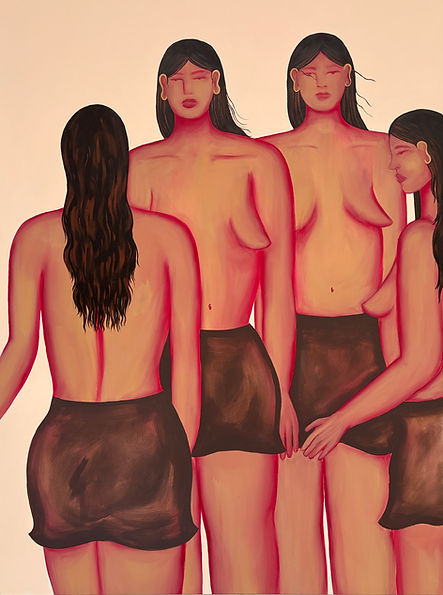
In this new series of paintings, Coppieters captures women in motion, dancing, flowing, and radiating joy, set against hard-edged, vibrant painted backgrounds. Her figures, often depicted in groups, possess a mysterious beauty: they move delicately, have soft anonymous faces with almost impassive expressions.
Coppieters’ women are celebrated in their authenticity, with bodies that defy traditional ideals of perfection. Limbs stretch and curve in unconventional ways and postures embrace natural imbalance. These figures are not idealized fantasies but real, tangible presences: Everywomen, in all their imperfect, human grace.
Inspired by the women in her life, Coppieters transforms familiar, intimate influences into personal mythologies. Her works are creating a vision of women who are both liberated and profoundly relatable.
More info about the artist
SAMIRA HODAEI
Born 1981, in Tehran, Iran.
Lives and works between Tehran and Berlin.
Hormuz After the Rain
This series is based on images taken around Hormuz Island after the flood of December 2025. Following heavy rainfall, the island’s red soil flowed into the waters of the Persian Gulf, altering the color of the sea. The images return to an event that, through its repeated return to a condition, loses its clear beginning and end and enters a continuous cycle of repetition.
The landscapes in this series are built gradually through thousands of colored dots. From a distance, the image approaches a legible landscape; up close, it turns into a surface of dots, stains, and colored sediments. The accumulation of dots slows the gaze and disrupts the rapid consumption of the image.
Alongside the paintings are drawings made with a red pen on small sheets of paper, produced between late February and March 2026, during a period of instability and displacement caused by war. These drawings are daily and repetitive records of the red waters of Hormuz Island. They are not preparatory sketches for the paintings, but both a record and a return to a skin-like remnant of that period; something between landscape, document, and residue.
Portraits — Cinema Europe
This series of paintings is part of an installation called ‘Cinema Europe’ that was made in 2018, a series of painted portraits inspired by ‘martyrs’ of the Islamic revolution, which referenced a specific genre of representation used by the government’s propaganda machine. Besides remembering the deceased, the main goal of these official images is to show that the martyrs are considered the true ‘living ones’ who become witnesses to our daily dealings. Hodaei’s work replaces the men with women, who thus become the real ‘witnesses’ of society.
In her paintings, Hodaei works with glass paint on canvas, building images through thousands of individual dots of color. These works move between pixelation and texture; abstract up close and legible from a distance. Through the accumulation of dots, the image slows the gaze and resists rapid consumption.
More info about the artist


Natacha MANKOWSKI
FINS BOIS, From the Thenac Series, 2025
Oil, wax, pigments, stone powder and dried plants from the Thénac quarries, Cognac, France, on wood panel - Frame by the artist
32 x 25 x 5 cm
NATACHA MANKOWSKI
Born in 1986 in Paris, France.
Lives and works in Amsterdam, Netherlands..
For this exhibition, Natacha Mankowski presents 2 series of paintings : Cognac and Gyali. One was made in France and the other in Greece.
In early 2025, Natacha dug the ground from the quarries of Aquitaine in West France. She gathers fragments of territory : beeswax, linseed oil, walnut oil, but mostly sand, clay, and various limestones. These last, collected from Cognac vineyards and Thénac Saintonge underground quarries were translated into naïve geographies molded in oil pastels. The palette is restrained and mineral. A camaïeu of greige unfolds — from grey to beige — echoing the pale stone of Cognac. The paintings hold a diffused, soft luminosity. Light celadon and yellow clay backgrounds with hints of sea green and turquoise blue.
Later in 2025, Natacha spent several weeks on the volcanic islands of Gyali and Nisyros studying two materials: pumice and obsidian. From this period of field research emerged a new body of paintings that navigates between light and dark, translating the richness of the volcanic landscape and the complexity of its geological formation. The island of Gyali is shaped by two seemingly opposing materials born from the same volcanic system. Pumice is a light, porous rock created through explosive fragmentation, while obsidian is a dense, vitreous volcanic glass formed by the slow cooling of silica-rich lava. Executed in a camaïeu of blacks, whites, and coloured greys, punctuated by traces of pink and red clay, the paintings are directly embedded with pumice and obsidian, allowing the geological strata to emerge through the painted surface. This coexistence of fragility and solidity, two radically different expressions of the same magma beneath the Nisyros volcanic field, makes Gyali an exceptional geological site through which to better understand the forces that shape our world.
More info about the artist
DONGLAI MENG
Born 1994, Dalian, China.
Living and working between the Netherlands and China
"Urban legends are strange, terrifying, or mysterious stories that circulate in contemporary society. They often take place in urban settings and feature distinctly modern elements, which set them apart from traditional folklore. The study of urban legends is multidisciplinary, intersecting anthropology, sociology, psychology, and literature. These stories are passed down through oral tradition or spread online, constantly reshaped as they travel. While their details may vary, many share the same emotional core—fear of unknown creatures, environmental pollution, racial prejudice, or rapid social change. They reveal how collective anxiety spreads through imagination, embedding itself in the fabric of everyday life.
In the Broodje Aap series, I translate these narratives into immersive visual experiences, constructing dreamlike and unsettling scenes where reality blurs with fiction. Through figurative painting, I explore the psychological weight carried by these myths, capturing their eerie familiarity and quiet unease. The works invite viewers into a liminal space—neither fully real nor entirely imagined—where the mundane is subtly transformed into something uncanny."
– Donglai Meng


SALI MULLER
Born 1981 in Luxembourg.
Lives and works in Luxembourg.
At the center of Sali Muller’s work lies a simple yet unsettling question: what does it mean to see oneself? Through mirrors, light, and reflective surfaces, the artist creates environments in which perception becomes unstable and identity appears fluid. Her installations do not merely reflect the viewer’s image; they expose the fragile relationship between self, space, and society. Suspended between clarity and illusion, these luminous landscapes invite a moment of pause — a space where seeing becomes self-reflection, and reality reveals itself as something constantly shifting.
Reflections, shimmering colours, and the visual transformations triggered by the viewer’s movement create a harmonious and immersive experience. By combining conceptual sculptural strategies with a network of recurring themes central to her creative process, Muller expands the boundaries of traditional artistic forms and contributes to the emergence of what she defines as Ultra-Contemporary Art.
More info about the artist
SAAR SCHEERLINGS
Born 1990 in Eindhoven.
Lives and works between Amsterdam and France
Saar Scheerlings embarked on her artistic journey after studying at the Design Academy Eindhoven and gaining experience as a chef and theater designer.
Saar mixes the disciplines of art, design and craft to find processes that give rise to new types and expressions. Her work includes large ceramic vessels that serve as painted maps, decanters that seem unwilling to pour, paintings that resemble fabrics and soft monumental sculptures.
For her, a medium is not defined: she prefers to create her own playing field and associated rules. A great interest in daily life probably comes from her education in design, but she is not very interested in the way products are industrially designed, made and used.
She prefers to see forms as intermediate phases of a creative process, a game, a tradition, a ritual, a culinary dish. It is the commitment to this process that gives objects meaning.
Saars work is often triggered by the beauty and dedication of old materials like the antique linens she finds at garage sales in the French countryside where she lives. With a laborious process of sculpting, cutting, sewing and weaving she breathes new life into these materials, transforming them into her monumental talisman sculptures.
Weaving is not only a technique for Saar, it is a metaphor for her entire work. She sees her oeuvre as an expanding structure. She not only creates work, she works on her own culture.
More info about the artist
.png)
Saar Scheerlings
Sherman, 2026
Foam, linen and cotton dyed with tea and iron, stained oak
90 x 54 x 15,5 cm